
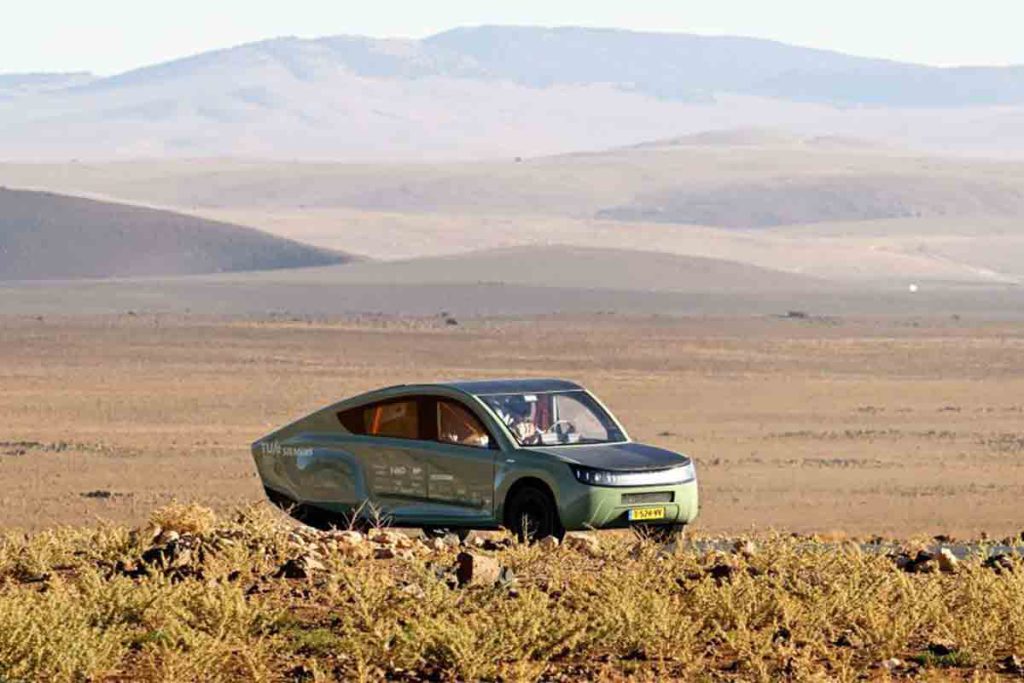
A group of students from Eindhoven University of Technology in the Netherlands has built and tested the world's first solar-powered off-road car. The car, named Stella Terra, covered around a thousand kilometers across the Sahara without any problems.
Why solar cars?
Electric vehicles are one way to reduce transport emissions; however, how much they actually benefit the environment depends largely on the source of the electricity they draw from the grid. Upgrading the entire grid to renewable sources is difficult and slow, but each vehicle can be made grid-independent by fitting solar panels.
So far, most efforts in solar vehicles have remained at the prototype stage. Projects such as Lightyear, which went into production last year, were halted because of commercial problems. However, Solar Team Eindhoven has a successful track record in this field; they previously built a solar camper van and completed a 2,000-kilometer journey with it in 2021.
Development team
Solar Team Eindhoven, made up of students from Eindhoven University of Technology, has repeatedly taken first place in prestigious competitions such as the World Solar Challenge in Australia. Their continuous efforts to improve solar vehicle performance have now led to the first solar-powered off-road vehicle. In 2021, the group also introduced a vehicle called "Stella Vita".
Solar SUV
Today, electric SUVs are nothing new in the automotive industry, and several companies produce them commercially. But because of their larger dimensions, these vehicles need bulkier batteries, which drives up overall weight.
The Dutch team took this into account in its design and built an SUV that weighs about a quarter less than typical models. Because the car's battery is charged by its solar panels while driving, a smaller battery can be used, which reduces the vehicle's weight.
Stella Terra ended up as a 1200 kg car with a top speed of 145 km/h and a range of about 630 km on a sunny day.
Design from scratch
The solar panels on the car's roof provide the energy needed, but Stella Terra's key point is what lies under the hood. Because the car has to withstand rough terrain, the engineers could not use off-the-shelf parts from ordinary cars; and since there was no precedent for this kind of vehicle, outside sources could not be used either.
For that reason, the team designed all of the car's parts and systems from scratch, including the suspension and the solar panel converters. Because the Netherlands has limited sunshine and the vehicle was designed for off-road routes, they decided to carry out extensive testing in Morocco.
Wisse Bos, the team manager, said: “Almost everything, from the suspension to the solar panel converters, was designed specifically for Stella Terra and by ourselves. Our team has pushed the boundaries of technology, and we expect this car to reach the market within the next five to ten years.”
Trip to Morocco
Stella Terra's off-road capabilities were put to the test on a journey through Morocco. The two-seater crossed the mountainous terrain of the rugged Rif range, climbed steep grades, travelled to one of Morocco's highest cities and then entered the sandy tracks of the Sahara.
During the trip, the car's steering failed, but it was repaired using parts available locally.
Other features
Because the car is designed for long journeys, the team fitted reclining seats to provide a comfortable space for rest. Besides powering the drive, its solar panels can also be used for cooking and charging mobile phones.
Stella Terra's solar panels are said to be able to convert 97 percent of the absorbed light into electrical energy. This efficiency let the car perform about 30 percent better than the team's initial predictions.
Future outlook
Solar Team Eindhoven consistently introduces new technologies as prototypes years before commercial release. The group hopes its recent successes will encourage carmakers to build vehicles with better environmental performance and larger batteries.
The success of this journey showed once again that there is no limit to developing environmentally friendly vehicles, and that the move toward clean technologies can be made faster.