
Using mirrors, Australia has taken an important step in solar power generation. The significance of this technology is that it makes it possible to store renewable energy and make greater use of it.
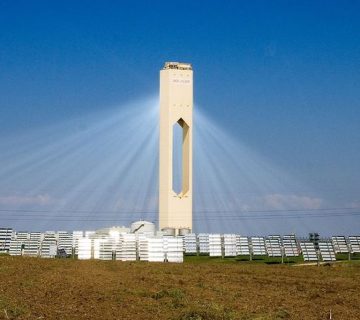
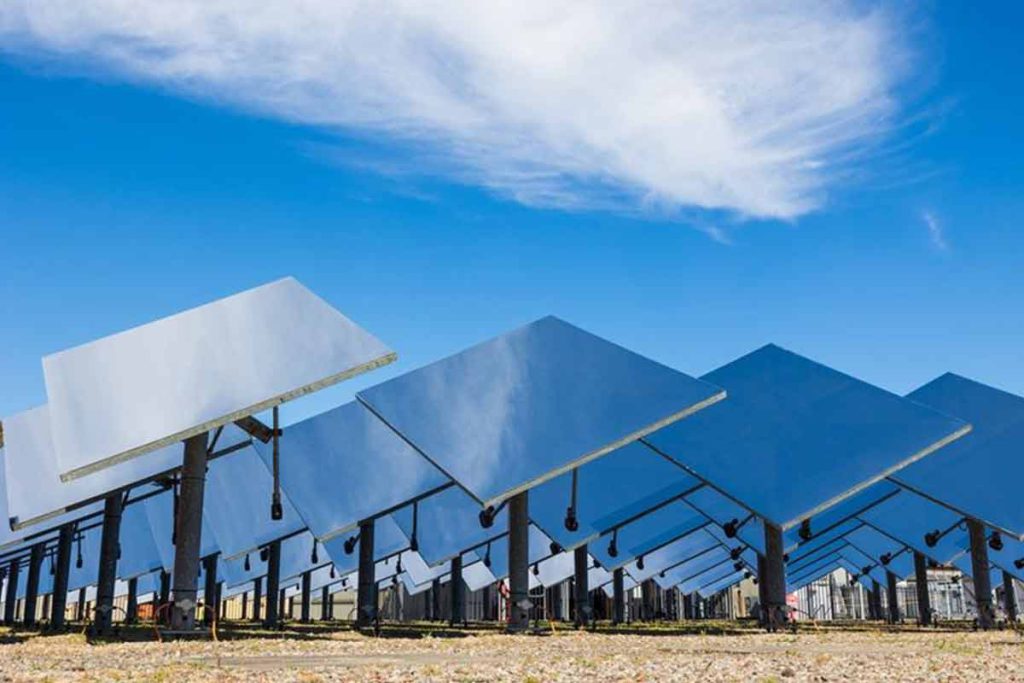
According to a Hoorayesh report citing Bargh News, concentrated solar thermal technology or CST uses a set of sunlight-collecting systems to produce heat or electricity. The principle seems simple, but doing it effectively requires large mirrors or lenses that concentrate sunlight onto a small point called the receiver — a technically challenging task.
These mirrors — also known as solar collectors — come in several designs, including dish systems, solar towers and parabolic structures. Each of these designs concentrates sunlight in its own way.
In this technology, the receiver sits at the center of the system, and its job is to convert concentrated sunlight into thermal energy. Inside this receiver there are usually materials such as molten salt or high-temperature oils that absorb and transfer the heat.
A major achievement
That said, concentrated solar thermal technology is not without drawbacks. It needs suitable weather conditions and steady sunshine to perform well, and its implementation cost is also relatively high.
However, Australia's national science agency (CSIRO) has made remarkable progress in this field, which could have an impact not only for Australia but on a global scale.
Australian researchers have for the first time succeeded in reaching a temperature of 803 °C in these receivers — a figure regarded as a major milestone in the development of this technology.
Dr. Jin-Soo Kim, who leads the solar technologies team at CSIRO, says this achievement is highly significant because, when combined with their dedicated heat exchanger, the technology makes it possible to store a greater amount of renewable energy.
He also stresses that this technology could play an important role in providing cheap, widely available energy for Australia's heavy industries and help cut carbon emissions. According to him, reaching this milestone was the result of more than eight years of research, sustained effort and extensive investment.
The role of ceramic particles in improving performance
In this new technology, ceramic particles are used — materials that can withstand temperatures above 1000 °C — and by absorbing and storing the sun's heat, these particles simplify the system's structure and reduce energy costs.
This innovation is very significant compared with common CST methods, because older designs typically used materials that could only withstand temperatures of 400 to 600 °C — which is why this advance could be a powerful alternative to solar systems based on photovoltaics (PV) in some applications.
Competing with photovoltaics or complementing them?
However, experts believe concentrated solar thermal technology is not meant to be a direct competitor to photovoltaics. Dominic Zaal, head of the Australian Solar Thermal Research Institute, explains that the two technologies are in fact complementary.
According to him, photovoltaic systems generate electricity while the sun is shining, but concentrated solar thermal technology can capture and store the sun's energy so it can be used at times such as night or on cloudy days.
Development outlook for this technology
At present, in the city of Newcastle, around 400 mirrors have been used in the CSIRO pilot system. However, to set up a complete industrial-scale system, probably more than 10,000 larger mirrors will be needed.
Such a system could deliver power equivalent to a coal-fired plant of 100 MW; something that shows this technology has great potential for large-scale energy supply.
Economically, the approach is promising too. According to Dominic Zaal, renewable thermal technology could reach profitability in about five years and full return on investment in about ten years is achievable.