

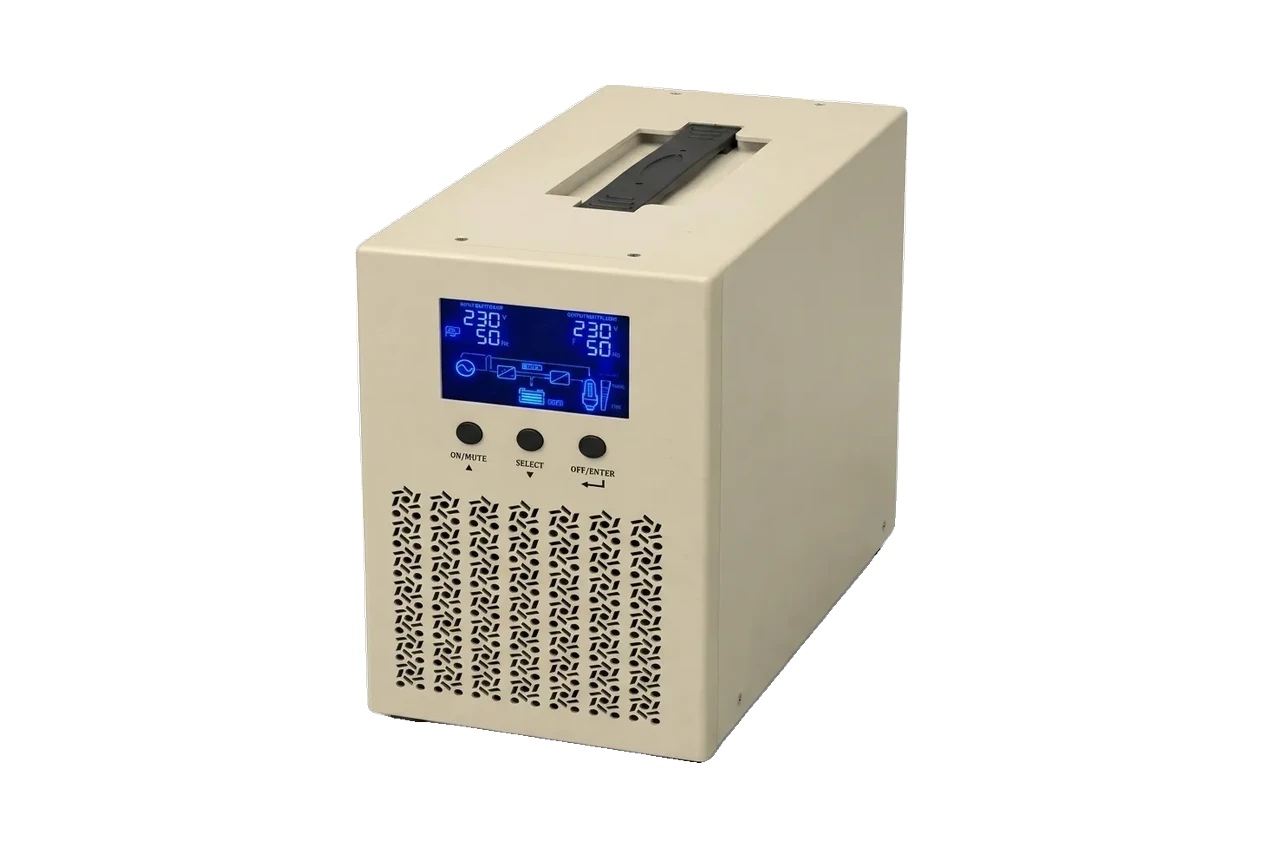
Industrial UPS is the link between the power grid and loads that cannot tolerate even a few milliseconds of interruption: control rooms, PLCs and protective relays, instrumentation, telecom equipment and servers. This page presents the product specifications, the differences between UPS families and the selection criteria.
The single-phase online UPS from “Keyhan Energy” (registered name: “Keyhan Energy Trade Development”) has one clear technical distinction: The unit's control software was designed and written by the company itself. That means the battery-charging logic, the unit's behavior under voltage sag and the structure of its alarm messages are known and documented within the company, and the technical team does not depend on a third-party manufacturer's black box for support.
What is a UPS and why is it critical?
A UPS, with energy stored in its battery, keeps feeding the load without interruption the moment mains power fails or sags. But in industry, a complete blackout is only one of the threats: momentary voltage dips when large motors start, frequency swings on a generator, transient overvoltages and harmonic distortion also reset or damage electronic boards.
The real cost of an interruption is not the price of a burnt-out device; it is a stopped production line, a spoiled product batch and lost monitoring data. The UPS is therefore part of the power-supply system design and must be selected together with the Industrial Battery and its charging path.
Types of UPS
The three main UPS families differ fundamentally. In Offline (Standby) units, the load normally runs directly on mains power and is transferred to the inverter only during an outage; inexpensive, but with a noticeable transfer time. In Line-interactive units, a regulating transformer corrects the voltage in steps, but the output frequency still follows the grid. In online double-conversion units, the input is rectified and converted back to AC; the load is always fed from the inverter output, and grid noise does not reach it directly.
The criterion for choosing among these three is the load's sensitivity to interruption and the quality of the site's incoming power. The more sensitive the load is to brief outages and the less stable the incoming grid, the stronger the technical case for an online topology; conversely, offline and line-interactive are the more economical choice for low-sensitivity office loads on a reasonably stable grid. The Keyhan Energy product belongs to the online, double-conversion family.
Keyhan Energy 1 kVA online UPS specifications
The following specifications are taken from the company's official catalog (UPS catalog, 14 Mordad 1405 / 5 August 2026):
| Capacity | 1000 VA / 800 W |
| Topology | Online, double conversion |
| Output waveform | Pure sine wave |
| Output voltage | 220 V, ±2% to ±3% |
| Output frequency | 50 Hz, ±1% |
| Input voltage | 170 to 265 V, single-phase |
| Transfer time | 0 ms (transfer to bypass: 4 ms) |
| Efficiency | Up to 90% on mains · up to 85% on battery |
| Battery type | 12 V sealed lead-acid (SLA) or 12.8 V lithium iron phosphate (LiFePO4) |
| Charge current | 15 A for SLA · 20 A for lithium · up to 100 Ah |
| Operating temperature | −10 to +50 °C |
| Noise level | Less than 50 dB |
| Protection | 16 hardware and software layers, with alarm and LCD display |
| Control software | In-house; designed and written by Keyhan Energy |
Supporting both battery chemistries in one enclosure leaves the choice to site conditions: sealed lead-acid with a lower initial cost, or lithium iron phosphate with longer cycle life and lower weight. Battery bank specifications are on the Industrial Battery page, and for standalone charging of either chemistry, Sealed Lead-Acid (SLA) Battery Charger and Lithium Battery Switching Chargers can be used.
Industrial UPS selection guide
For a proper selection, the following five criteria are reviewed in order:
- Nature of the load: Linear or switching? What are the power factor and inrush current? Both apparent power (VA) and active power (W) must be checked.
- Backup time: Is the goal only a safe shutdown and transfer to the generator, or continued operation until the end of the shift?
- Incoming grid quality: The unit's input acceptance range must match the reality of the site — weak grid or generator.
- Environmental conditions: Temperature, dust and ventilation; high temperature shortens battery life.
- Maintenance: Spare-parts availability, on-site battery replacement and technical support responsiveness.
If your load needs direct DC supply instead of AC — as telecom systems do — a UPS is not the right solution; what you need is a Telecom Rectifier — and if only controlled charging of a battery bank is required, consider the Battery Charger.
In-house control software and related product lines
This product's main distinction is in the software layer: the control code was written in-house and its documentation is held by the manufacturer's technical team. The practical result for the buyer is closer technical support and faster fault diagnosis, because the unit's behavior can be explained at the level of control logic.
The UPS is not the company's only product line, and that creates a shared technical foundation: Telecom Rectifier, Cathodic Protection Switching Power Supply, Sealed Lead-Acid (SLA) Battery Charger and Solar Inverter all share a common core of power electronics and digital control. In solar energy, the 400 kW Bardaskan, 400 kW ISACO and 200 kW Loshan plants have been delivered; these projects are described on the Solar Power Plant page.
For projects that need ancillary items in addition to the main equipment, Equipment Supply is among the company's services. Warranty terms are as announced by the company.
UPS classification per IEC 62040-3
The international standard IEC 62040-3 defines how UPS performance is declared and how it is tested, giving a common basis on which two manufacturers' datasheets can be compared.
The important point for the buyer is this: any code or performance class a seller declares must be the result of testing and be stated in the manufacturer's published specification sheet, not an advertising claim. The text and tables of the standard are not reproduced here; for the exact clauses, refer to the official version of the standard.
Capacity and backup time calculation
The calculation has three steps: adding up the load (active power in watts and apparent power in VA, separately; the unit's rating must cover both), adding a growth margin for future loads, and converting the required backup time into battery energy.
The basic relation of step three: energy required from the battery equals the load's active power multiplied by backup time, divided by the battery-path efficiency. This energy is then converted to amp-hours using the bank's nominal voltage, and finally the allowable depth of discharge and capacity loss from temperature and aging are applied — otherwise the estimated backup time may exceed what is achievable under operating conditions.
Two common errors occur at this very step: ignoring the difference between watts and volt-amperes, and overlooking that a battery's nominal capacity is stated at the reference temperature and standard discharge rate, not under real site conditions. To estimate capacity and backup time, UPS Calculator is available; for solar-side calculations, the Solar calculator.
Acceptance tests you should require from the supplier
Acceptance tests and a written report of their results must be specified in the inquiry and contract documents. The list below is a basis for defining the required items and obtaining documentation from the supplier.
- Visual and wiring inspection: Conformance to drawings, tightness of connections, terminal labeling.
- Output voltage and frequency test: At no load and under load, within the stated range.
- Load and thermal stability test: Continuous operation at rated load with hot-spot temperature monitoring.
- Input interruption and restoration test: Output continuity when mains power suddenly fails and returns.
- Bypass test: Transfer to bypass and back, with load behavior checked.
- Battery charge and discharge test: Correct charging profile for the battery chemistry and low-voltage cut-off.
- Alarm and display test: Correct messaging and operation of the protection layers under a simulated fault.
The written report of these tests is the basis for acceptance and the reference for later troubleshooting; agreeing on it before ordering eliminates the cost of disputes later.
Frequently asked questions about the industrial UPS
What is the difference between volt-amperes and watts when choosing a UPS?
Volt-amperes are apparent power and watts are active power. Keyhan Energy's 1 kVA unit delivers 800 W of active power; if the total wattage of the loads exceeds this, the unit cannot cope even if the VA seems sufficient.
What practical advantage does an online UPS have over line-interactive?
In online double-conversion, the load is always fed from the inverter output; the transfer time is zero milliseconds and grid noise does not reach the load directly. In line-interactive, the output frequency still follows the grid and voltage correction is done in steps.
Lead-acid or lithium battery: which option is right?
The unit supports both: 12 V sealed lead-acid with 15 A charging, and 12.8 V lithium iron phosphate with 20 A charging, up to 100 Ah. The choice depends on budget, permissible space and weight, and the expected number of cycles; bank specifications are on the Industrial Battery page.
What environmental conditions does the unit operate in?
Operating temperature range is −10 to +50 °C and noise level is below 50 dB. Battery life is nonetheless sensitive to temperature, so allow for proper ventilation at the installation site.
How does a UPS relate to a generator?
The two are complementary. A UPS covers the gap from the start of an outage until the generator starts, and also corrects power quality; the generator is for long-term continuity. At generator-backed sites, the UPS input acceptance range must be compatible with the generator's output.
Technical consultation and quotes
Contact us to review the site load list and request a quote. If the project also has a solar side — such as emergency power alongside a Solar Inverter — submit the same enquiry for both subjects. The list of services is on the Services page.
- Phone: +98 996 617 1347
- Email: info@keyhanenergy.net
- Address: Tehran, Shahrak-e Rah-Ahan, Shayan Complex Street, Amir Kabir Boulevard, Block E, 3rd Floor, Unit 3 — Postal code 1493868543
To submit a quote request, use the form on the Contact us.
UPS selection step guide
- Types of UPS — the difference between offline, line-interactive and online, and which load each suits.
- UPS capacity and backup time calculation — formulas and a worked example.
- Online UPS calculator — enter your load list to see the unit rating, battery, input breaker and minimum generator size.
- Keyhan Energy 1 kVA online UPS — the unit's technical specifications.
- UPS with lithium iron phosphate battery — works with LiFePO4 batteries.