

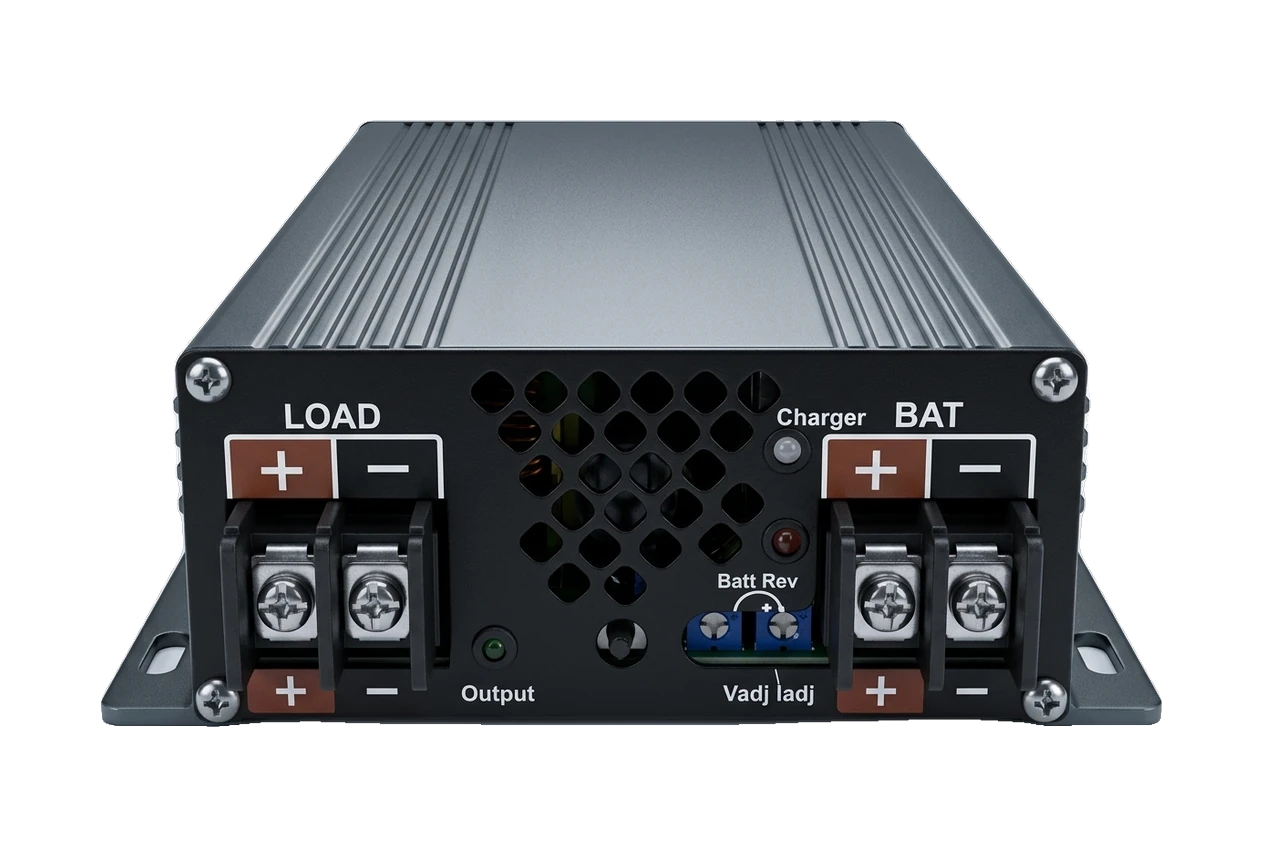
Keyhan Energy manufactures the Industrial Battery Charger range — from Battery Charger models for sealed lead-acid batteries in UPS systems to switching chargers for lithium packs in solar and telecom systems. Designed and built in Iran, with direct manufacturer support.
Our products
- Sealed Lead-Acid (SLA) Battery Charger — three-stage CC/CV/Float charging, reverse-connection protection; suitable for UPS and emergency power.
- Lithium Battery Charger — CC/CV stages with automatic cut-off; compatible with Li-ion and LiFePO4.
- Telecom Rectifier — regulated DC supply with smart charging of the site's backup battery.
Why choosing the right charger matters
Most premature battery failures are the result of incorrect charging: constant overcharging damages the battery plates and undercharging causes sulfation. A standard three-stage charger — constant current, constant voltage, float — is what determines a battery's real life.
Battery charger selection guide
- Battery chemistry: sealed lead-acid and lithium have different charging profiles — the charger must match the battery chemistry
- Bank voltage (12/24/48 V) and charge current (usually 0.1 to 0.2 of battery capacity)
- Protections: reverse polarity, short circuit, temperature
- Application: permanently connected stationary (float) charger or portable charger
Custom manufacturing to the project's required specifications is available — Custom manufacturing and localization. To request a quote Contact us. Related: Industrial Battery · UPS
The right charge profile; the heart of charger design
What sets an industrial charger apart from a simple power supply is the charge profile — for lead-acid (VRLA/sealed) batteries, the classic reference is the three-stage IU0U profile based on DIN 41773: a constant-current stage (Bulk), a constant-voltage absorption stage (Absorption, typically around 2.40 V per cell at 25 °C) and a maintenance stage (Float, typically 2.25 to 2.28 V per cell). For a six-cell 12 V battery that means absorption at about 14.4 V and float at about 13.5 to 13.7 V.
Temperature compensation is not optional: lead-acid charging voltage must be corrected at a slope of about −3 to −5 mV per degree per cell relative to 25 °C. Worked example: at 35 °C ambient (10 degrees above the reference) with a −4 mV slope, the float voltage of a 12 V battery must be reduced by 6 × 10 × 0.004 = 0.24 V; that is, about 13.36 V instead of 13.60. A charger without a temperature sensor in a hot climate can overheat the battery and shorten its life.
For lithium batteries (including LiFePO4) the logic is different: charging CC-CV with a precise end-of-charge voltage, current cut-off at the set threshold, a holding stage only as recommended by the manufacturer, and coordination with the BMS via enable/disable lines or CAN/RS485 communication. Connecting a lithium battery to an ordinary lead-acid charger is a safety risk and voids the warranty; use a lithium-specific charger.
Sizing the charger — worked example
The starting rule for stationary lead-acid is a charge current of about C/10. For a 200 Ah bank that means a charger of 20 A. The recovery time from a 50% discharge can be estimated:
Required amp-hours ≈ 100 Ah × charge-efficiency factor ~1.15 ≈ 115 Ah → 115 ÷ 20 A ≈ 6 hours Bulk phase + 2 to 3 hours of absorption phase to full charge.
If your bank backs up a UPS or a telecom site, the charger current must supply the permanent DC load at the same time as charging the battery; the sum of these two currents is used when sizing the charger current.
Lead-acid or lithium? A comparison from the charging and operating perspective
| Criterion | Sealed lead-acid (VRLA) | Lithium iron phosphate (LiFePO4) |
|---|---|---|
| Charge voltage per cell | Absorption ~2.40 V, float ~2.27 V | CV typically ~3.5 to 3.65 V; maintenance per the manufacturer's specifications |
| Typical cycle life at DoD=80% | About 400 to 600 cycles | About 2000 to 4000 cycles |
| Temperature sensitivity | Requires temperature compensation of voltage | Charging restriction below 0 °C |
| BMS requirement | None (monitoring recommended) | Mandatory + charger coordination with the BMS |
| Behavior under repeated partial charging | Sulfation and capacity loss | Much better tolerance |
Protections and related standards
Minimum protections for a dependable industrial charger: output overvoltage (OVP), overcurrent and short circuit (OCP/SCP), reverse polarity, and overtemperature (OTP). For stationary lead-acid batteries, the IEC 60896 series (parts 11, 21 and 22) is the reference for requirements and tests, and the battery manufacturer's recommended charging regime is expected to be stated in the datasheet on that basis; the charger must be able to implement exactly that regime.
Frequently asked questions
Can I charge a lithium battery with a lead-acid charger?
No. The profile, cut-off voltage and float behavior differ, and without coordination with the BMS there is a safety risk.
Is it acceptable to keep the battery on float permanently?
For VRLA batteries in standby use, yes; the float voltage and temperature-compensation requirements must follow the manufacturer's specifications. For lithium batteries there is no single rule: some manufacturers define a float stage at a specified voltage for a particular model. That battery's own profile and BMS requirements are the basis for charger selection and setting. Sources: Yuasa VRLA guide and Victron Lithium Smart battery manual.
What causes a new battery to fail early?
Three common causes: wrong float voltage, no temperature compensation in a hot climate, and repeated partial charging after deep discharges. All three come back to charger selection and setting, not to the battery itself.
How many parallel battery strings are allowed?
With equal-length, equal-resistance cabling and an independent fuse for each string, limited paralleling is common; but current sharing must be measured and documented at commissioning.
For a precise selection based on the project's actual battery bank and load, Request a quote or see production samples on the Sealed lead-acid charger and Lithium charger pages.