

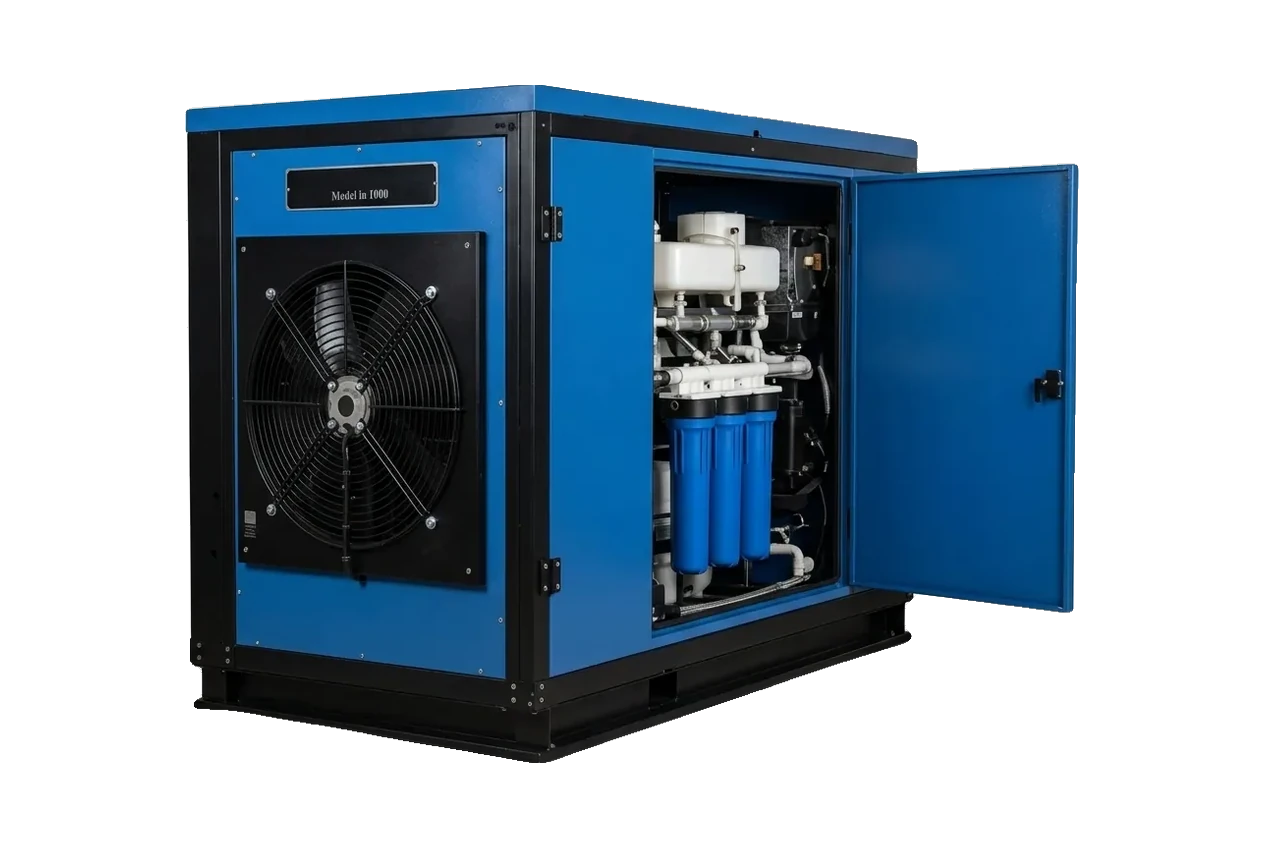
This unit is a self-contained, technology-driven solution for a sustainable supply of drinking water. It extracts the moisture present in ambient air and, through advanced stages of condensation, filtration, purification and disinfection, turns atmospheric humidity into clean, potable water. Operating independently of conventional distribution networks, this technology is an ideal option for areas with adequate humidity and limited access to water resources; given the climate of southern Iran and neighboring countries, in addition to producing high-quality water, the system can also serve as an effective means of cooling and freshening the air at industrial sites, workshops, villa complexes and commercial centers.
Download the product catalog PDF · 3 pages · 3.3 MB
Related pages
- Solar Power Plant — Turnkey design and implementation
- Solar and industrial inverters — selection and supply guide
How does an atmospheric water generator (AWG) work?
The atmospheric water generator turns the moisture always present in the air into drinking water. In the most common technology (refrigeration condensation), air passes over a surface cooled by a refrigeration cycle; wherever the surface temperature falls below the dew point of the air, the water vapor condenses, is collected and, after several stages of filtration and UV disinfection, goes to the tank.
Example: in 30°C air at 60% relative humidity, the dew point is about 21°C — meaning any surface a few degrees cooler than this will continuously produce water. Within the unit's operating range, higher temperature and humidity increase production capacity.
What factors determine the production capacity?
The rated capacity of any AWG is stated under specific test conditions; actual output depends on your climate:
- Relative humidity and temperature: The most important factor. As humidity drops, the water that can be extracted from each cubic meter of air decreases, and at low humidity (typically below about 30%) the output of refrigeration-based technology falls sharply.
- Specific energy: In the technical literature for this field, the energy consumption of refrigeration-based technology is usually reported in the range of about 0.3 to 0.8 kWh per liter and depends on the site's temperature/humidity and design quality; when comparing two units, compare the stated figures under the same test conditions.
- Inlet air quality: Dust clogs the air filter quickly; in dusty climates, a shorter filter service interval is specified.
Because water production depends on the power supply, combining the AWG unit with a Solar Power Plant can be considered for remote sites.
Atmospheric water generator technical specifications
The production capacity in the table below is the capacity under the stated operating conditions — water production from air depends directly on ambient temperature and relative humidity; at lower humidity or temperatures outside this range, actual output will be lower than the table value. To choose the right capacity, provide the installation site's climate data to our technical team.
| Parameter | Value |
| Production capacity | 250 liters per day (under the operating conditions below) |
| Operating temperature range | 15 to 45 °C |
| Suitable relative humidity | Above 70 percent |
| Power consumption | Three-phase, 32 A |
| Air inlet filter | Four-layer HEPA with activated carbon |
| Water purification system | Carbon, mineralization and UV — no reverse osmosis (RO) |
| Water collection tray | 316 stainless steel |
| Water storage tank | Polyethylene |
| Solar-powered | Feasible |
Why no reverse osmosis?
Water condensed from atmospheric humidity contains no hardness minerals to begin with, so the treatment path is completed with carbon filtration, mineralization and UV disinfection instead of RO. The result: simpler maintenance, no RO reject water and no water waste.
Information required for capacity selection
- The installation site and its climate — average temperature and relative humidity in the cold months of the year, not just summer.
- Daily drinking-water consumption in liters and the number of people or points of use.
- Available power: whether three-phase is present or must be provided; or whether solar supply is intended.
- Installation space, condensate drain route and access for periodic filter servicing.
To review your site conditions and select the right capacity, Contact the Keyhan Energy engineering team.
Water quality and hygiene
Condensate water is inherently low in minerals; what makes it "drinkable" is the treatment chain: particulate filter, activated carbon, a membrane if needed, and UV disinfection in the tank and at the dispensing line. In operation, periodic monitoring of TDS and free chlorine (if dosed), timely filter replacement based on operating hours, and tank cleaning must be recorded in the maintenance schedule so that water quality stays within drinking-water requirements (the WHO guideline framework and the relevant national standard).
Applications and selection criteria for atmospheric water generators
- Industrial, border and operational sites that have no clean water network but do have electricity;
- Coastal areas and islands with high humidity — the best climate for this technology;
- Backup drinking water for office/healthcare buildings, independent of tankers and bottles.
To select a model, have these four figures ready: daily water requirement (liters), the site's average temperature and humidity in the hot and cold months, available power, and the required level of purification. Keyhan Energy experts estimate the appropriate capacity and seasonal output based on this information; a fuller description of the supply process is on the Equipment supply page.
Frequently asked questions
How does the unit perform in a dry climate?
In a dry climate, production capacity falls and energy consumption per liter rises. Capacity selection or assessment of a combined solution must be based on the climate data of the installation site.
How is the quality of the produced water ensured?
With a filtration + UV chain and a documented periodic service schedule. The output water must be verified against drinking-water requirements in periodic testing.
How is the unit's power consumption assessed?
per liter, its consumption is within the stated range; for drinking-water use (not bulk process water) at sites where water delivery is costly or unreliable, its economics are usually defensible — especially in combination with solar power.